Organized by the Department of Economics, and approved by IQAC, The Bhawanipur Education Society College
Dates: 20th, 21st, 24th & 25th of July, 2020
|
Day 1
|
| Date |
20.07.2020 Monday |
| Time |
11-00 AM (IST) |
| Resource Person |
Dr. Somdeep Chatterjee, PhD (USA) |
| Assistant Professor & Chairperson, |
| Business Environment (Economics) Area |
| Indian Institute of Management Lucknow |
| Title of the Speech |
(En-)`lightening’ Children: Assessing the Impacts of Access to Electricity on Children’s Achievement Levels |
| Convenors |
Dr Anupa Ghosh, Ms Dyuti Chatterjee |
| Platform: |
Google Meet |
Day 2
|
| Date |
21.07.2020 Tuesday |
| Time |
11-00 AM (IST) |
| Resource Person |
Dr Abhiroop Mukhopadhyay |
| Professor |
| Economics and Planning Unit |
| Indian Statistical Institute (Delhi Centre) |
| Other Affiliations |
| Research Fellow, IZA (Bonn) |
| Associate Researcher, Centre De Sciences Humaines (CNRS) |
| Member, CECFEE |
| Title of the Speech |
Trust Thy Neighbour?: Evidence from Partition of India |
| Convenors |
Dr Purba Roy Choudhury, Ms Dyuti Chatterjee |
| Platform: |
Google Meet |
Day 3
|
| Date |
24.07.2020 Friday |
| Time |
6-30 PM (IST) |
| Resource Person |
Dr Nishith Prakash |
| Associate Professor of Economics |
| Department of Economics and Human Rights Institute |
| University of Connecticut |
|
| Affiliations: IZA, CReAM, GLO & HiCN |
| Fellow: Women and Public Policy Program, Harvard University |
| Title of the Speech |
Wheels of Change: Transforming Girl’s Lives with Bicycles |
| Convenors |
Dr Ivy Das Gupta, Ms Damayanti Sen |
| Platform: |
Google Meet |
Day 4
|
| Date |
25.07.2020 Saturday |
| Time |
6-30 PM (IST) |
| Resource Person |
Dr Ria Bhattacharya, Ph.D., University of Connecticut, USA |
| Visiting Assistant Professor |
| Elon University, USA |
| Title of the Speech |
COVID-19: G-20’s Response to Education |
| Convenors |
Dr Ivy Das Gupta, Ms Damayanti Sen |
| Platform: |
Google Meet |

India today is fractured critically by the pandemic, various mishaps, unrest, pressure from neighbouring countries and erroneous policies. She is in urgent need of reconstruction. Economists’ analysis of the policies adopted by the country at different time points and their insights into the policies to be taken up in the future, can be of utmost importance to restore India’s missing glory.
Given this scenario, the Department of Economics of The Bhawanipur Education Society College, organized a Four-Day Special Lecture Series on “Insights into Some Indian Policies”, where four eminent Economists shared their research findings and placed their opinions in this regard.
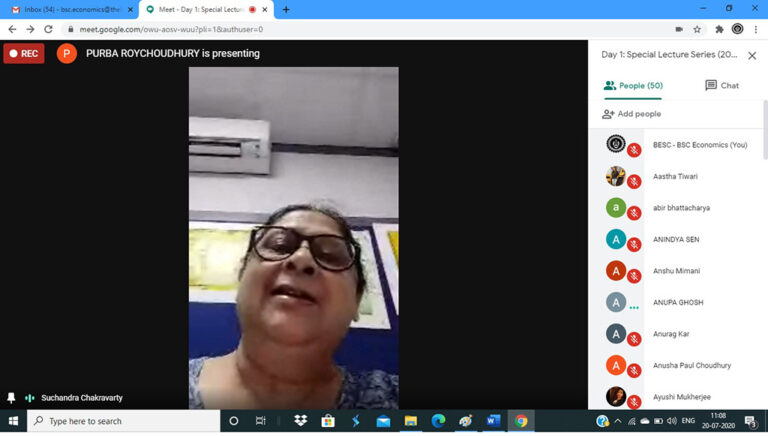
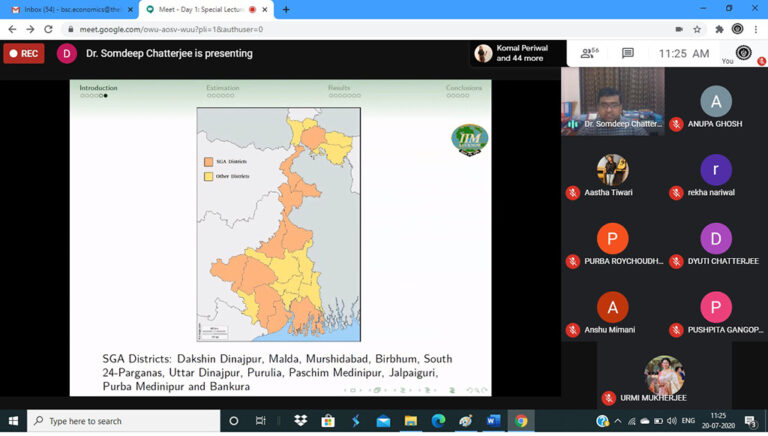
Day 1: 20.07.2020 Monday 11:00 AM (IST) – The four-day special lecture series was inaugurated by Teacher-in-Charge, Dr Suchandra Chakravarty with her speech. There were about fifty-seven participants, comprising students and faculty from within and also outside the college. The speaker of the day, Dr Somdeep Chatterjee, Assistant Professor, IIM, Lucknow, presented his research findings on whether access to electricity affects education. His research has exploited plausible exogenous variation in electricity access generated by a rural electrification project from the Indian state of West Bengal using a difference-in-difference estimation design. The reduced form estimates suggest that on average reading test scores of children increases by 3% and are more prominent for the younger cohorts. It is found that the program did not affect math test scores. There is evidence that the program led to increased access to electricity, both at the household and village level, conforming the potential mediating channels of the reduced form findings. The in-depth research invoked questions in the mind of the participants which were addressed by Dr Chatterjee after his presentation.
Lecture: Day 1
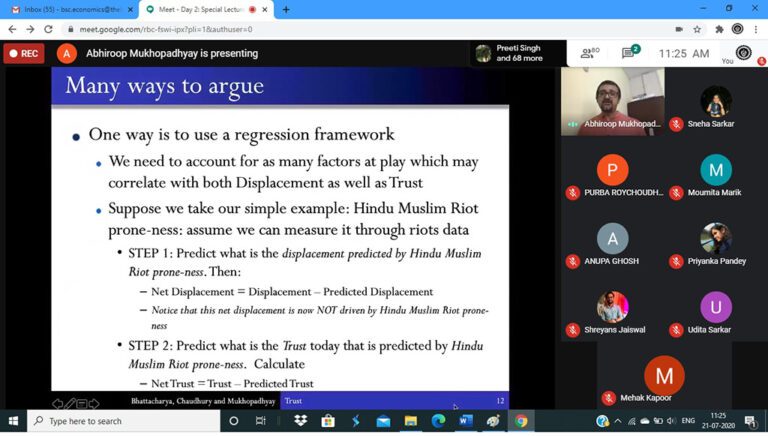
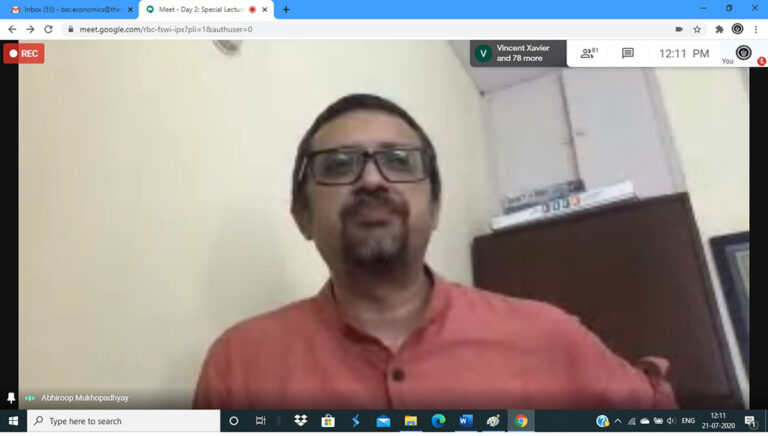
Day 2: 21.07.2020 Tuesday 11:00 AM (IST) – On Day 2, the session started with the Welcome Address by Dr Samir Kanti Dutta, Vice Principal (Science). The speaker of the day, Dr Abhiroop Mukhopadhyay, Professor, Economics and Planning Unit, ISI, Delhi, presented his findings on the long run effect of partition of India (especially that on the eastern border on India) on inter-personal trust. Around eighty-two participants, comprising both students and faculty from different institutions, attended the session. The research has used rich historical data from 1951 Census of India to calculate proportion of district population who were “displaced”. This data was merged to a rich contemporary household survey (SAGE: 2007) that measures indicators of inter-personal trust in six states of India. Results suggested that individuals who lived in districts where the proportion of displaced population was high, had less inter-personal trust. These results survive even after accounting for a host of geographical, historical and contemporaneous controls both at the district and at the household level. This effect is especially seen in the rural part of the sample, in particular for poorer villages. This lack of inter-personal trust is in-turn correlated to key economic outcomes of the household. The presentation attracted a large number of questions from the participants and Dr Mukhopadhyay’s answers lucidly explained each one of them.
Lecture: Day 2
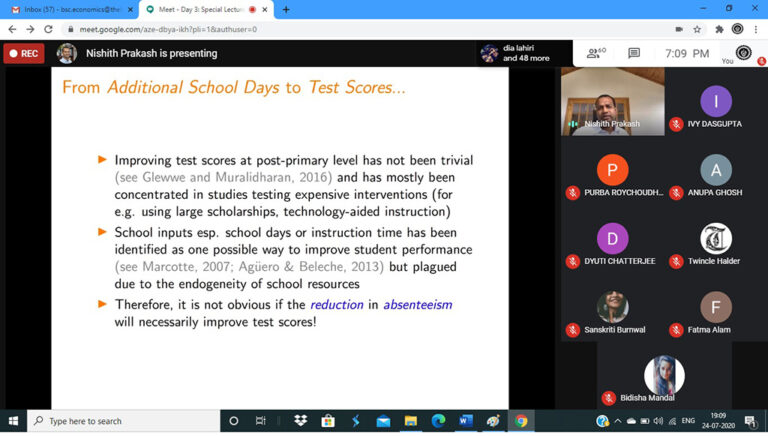
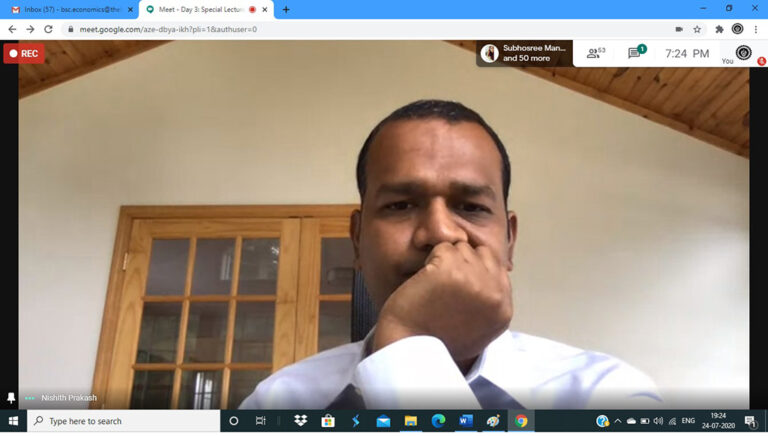
Day 3: 24.07.2020 Friday 06:30 PM (IST) – Day 3 had yet another important policy presented to the audience. The speaker, Dr Nishith Prakash, Associate Professor of Economics, University of Connecticut, USA, elaborated his findings on how the policy of providing bicycles to women actually transformed their lives for the better. Inspired by such policies in India, Dr Prakash had studied the impact of a program that provides bicycles to girls who live 3km or further away from school, directly addressing educational and empowerment outcomes of adolescent girls in rural Zambia. This is a conditional in-kind transfer (CKT) program student uses the bicycle to go to school. The study provided causal estimate of the program on girls’ educational outcomes and various measures of empowerment. The intervention reduced overall absenteeism, commute time, and late arrival to school, had modest (but non-trivial) impact on Math score, and impacted various measures of women empowerment (for e.g. locus on control, desired fertility, bargaining, pro-sociality, self-image, perception of safety, time-use, etc.). Overall, results from this study suggested a cost-effective scalable policy that addresses access to school problems in the short-medium run, especially in areas where the population is not dense. The presentation invited questions from the audience and Dr Prakash answered them satisfactorily.
Lecture: Day 3
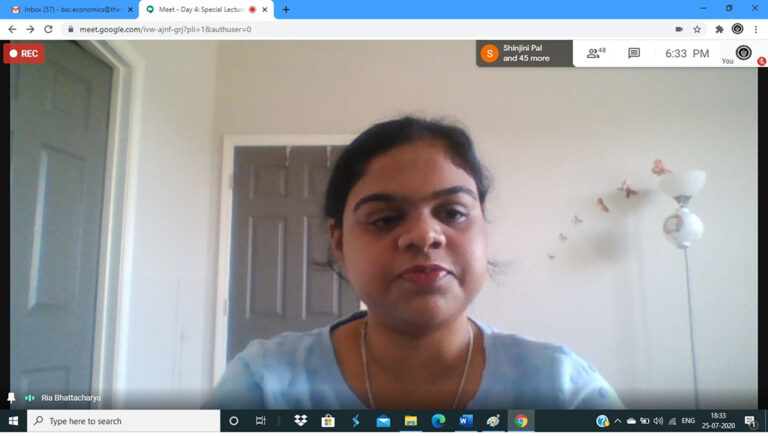
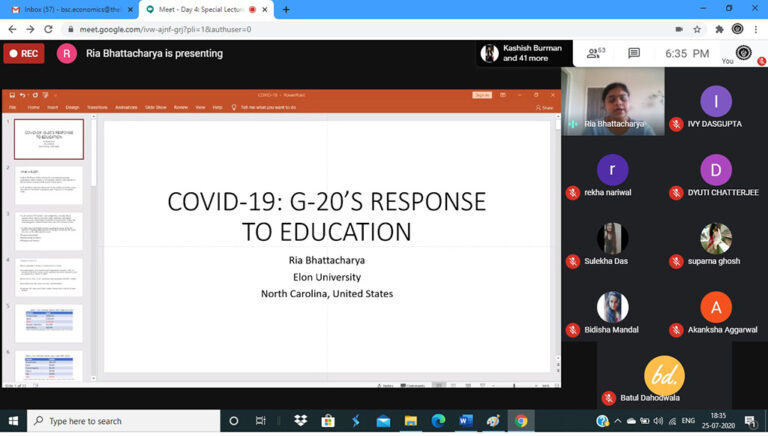
Day 4: 25.07.2020 Saturday 06:30 PM (IST) – Given the current scenario, no one can ignore the impact of COVID-19 on India and the world over and thus, on the fourth and final day, the session was dedicated to the response of G-20 to education, in the backdrop of COVID-19. Our speaker, Dr Ria Bhattacharya, Visiting Assistant Professor, Elon University, USA, examined the impact of COVID-19 pandemic on education. She discussed G-20’s current status in the education sector and its response to COVID-19’s impact on education. Her research highlighted the challenges thrust upon the G20 economies concerning education, a crucial sector in any economy. There are over 7 million confirmed cases globally, with the United States leading the death count at 100,000 deaths and counting, due to COVID-19. As the entire world braces itself for a severe recession comparable to the Great Depression which will have long-lasting effects on every sector of the global economy, she elaborated how G-20 nations could provide effective leadership during the current crisis.
Lecture: Day 4
The Four-Day Special Lecture Series on “Insights into Some Indian Policies” thus ended on 25.07.2020 with vote of thanks to all. Feedback of the participants was recorded for each day which ranged from satisfactory to excellent and e-certificates were distributed to the participants for each of the four days. Overall, this lecture series succeeded in providing a platform to our four eminent Economists
- To throw light on the grave situation being faced by India
- To explore the rich research that has been done on the policies adopted by India
- To enlighten on the policies that can help reconstruct India in the near future.
Glimpses of the Four-Day Special Lecture Series on “Insights into Some Indian Policies”
Organized by the Department of Economics, and approved by IQAC, The Bhawanipur Education Society College on 20th, 21st, 24th & 25th of July, 2020
 Day 1: 20.07.2020 Monday 11:00 AM (IST) – The four-day special lecture series was inaugurated by Teacher-in-Charge, Dr Suchandra Chakravarty with her speech. There were about fifty-seven participants, comprising students and faculty from within and also outside the college. The speaker of the day, Dr Somdeep Chatterjee, Assistant Professor, IIM, Lucknow, presented his research findings on whether access to electricity affects education. His research has exploited plausible exogenous variation in electricity access generated by a rural electrification project from the Indian state of West Bengal using a difference-in-difference estimation design. The reduced form estimates suggest that on average reading test scores of children increases by 3% and are more prominent for the younger cohorts. It is found that the program did not affect math test scores. There is evidence that the program led to increased access to electricity, both at the household and village level, conforming the potential mediating channels of the reduced form findings. The in-depth research invoked questions in the mind of the participants which were addressed by Dr Chatterjee after his presentation.
Lecture: Day 1
Day 2: 21.07.2020 Tuesday 11:00 AM (IST) – On Day 2, the session started with the Welcome Address by Dr Samir Kanti Dutta, Vice Principal (Science). The speaker of the day, Dr Abhiroop Mukhopadhyay, Professor, Economics and Planning Unit, ISI, Delhi, presented his findings on the long run effect of partition of India (especially that on the eastern border on India) on inter-personal trust. Around eighty-two participants, comprising both students and faculty from different institutions, attended the session. The research has used rich historical data from 1951 Census of India to calculate proportion of district population who were “displaced”. This data was merged to a rich contemporary household survey (SAGE: 2007) that measures indicators of inter-personal trust in six states of India. Results suggested that individuals who lived in districts where the proportion of displaced population was high, had less inter-personal trust. These results survive even after accounting for a host of geographical, historical and contemporaneous controls both at the district and at the household level. This effect is especially seen in the rural part of the sample, in particular for poorer villages. This lack of inter-personal trust is in-turn correlated to key economic outcomes of the household. The presentation attracted a large number of questions from the participants and Dr Mukhopadhyay’s answers lucidly explained each one of them.
Lecture: Day 2
Day 3: 24.07.2020 Friday 06:30 PM (IST) – Day 3 had yet another important policy presented to the audience. The speaker, Dr Nishith Prakash, Associate Professor of Economics, University of Connecticut, USA, elaborated his findings on how the policy of providing bicycles to women actually transformed their lives for the better. Inspired by such policies in India, Dr Prakash had studied the impact of a program that provides bicycles to girls who live 3km or further away from school, directly addressing educational and empowerment outcomes of adolescent girls in rural Zambia. This is a conditional in-kind transfer (CKT) program student uses the bicycle to go to school. The study provided causal estimate of the program on girls’ educational outcomes and various measures of empowerment. The intervention reduced overall absenteeism, commute time, and late arrival to school, had modest (but non-trivial) impact on Math score, and impacted various measures of women empowerment (for e.g. locus on control, desired fertility, bargaining, pro-sociality, self-image, perception of safety, time-use, etc.). Overall, results from this study suggested a cost-effective scalable policy that addresses access to school problems in the short-medium run, especially in areas where the population is not dense. The presentation invited questions from the audience and Dr Prakash answered them satisfactorily.
Lecture: Day 3
Day 4: 25.07.2020 Saturday 06:30 PM (IST) – Given the current scenario, no one can ignore the impact of COVID-19 on India and the world over and thus, on the fourth and final day, the session was dedicated to the response of G-20 to education, in the backdrop of COVID-19. Our speaker, Dr Ria Bhattacharya, Visiting Assistant Professor, Elon University, USA, examined the impact of COVID-19 pandemic on education. She discussed G-20’s current status in the education sector and its response to COVID-19’s impact on education. Her research highlighted the challenges thrust upon the G20 economies concerning education, a crucial sector in any economy. There are over 7 million confirmed cases globally, with the United States leading the death count at 100,000 deaths and counting, due to COVID-19. As the entire world braces itself for a severe recession comparable to the Great Depression which will have long-lasting effects on every sector of the global economy, she elaborated how G-20 nations could provide effective leadership during the current crisis.
Lecture: Day 4
The Four-Day Special Lecture Series on “Insights into Some Indian Policies” thus ended on 25.07.2020 with vote of thanks to all. Feedback of the participants was recorded for each day which ranged from satisfactory to excellent and e-certificates were distributed to the participants for each of the four days. Overall, this lecture series succeeded in providing a platform to our four eminent Economists
Day 1: 20.07.2020 Monday 11:00 AM (IST) – The four-day special lecture series was inaugurated by Teacher-in-Charge, Dr Suchandra Chakravarty with her speech. There were about fifty-seven participants, comprising students and faculty from within and also outside the college. The speaker of the day, Dr Somdeep Chatterjee, Assistant Professor, IIM, Lucknow, presented his research findings on whether access to electricity affects education. His research has exploited plausible exogenous variation in electricity access generated by a rural electrification project from the Indian state of West Bengal using a difference-in-difference estimation design. The reduced form estimates suggest that on average reading test scores of children increases by 3% and are more prominent for the younger cohorts. It is found that the program did not affect math test scores. There is evidence that the program led to increased access to electricity, both at the household and village level, conforming the potential mediating channels of the reduced form findings. The in-depth research invoked questions in the mind of the participants which were addressed by Dr Chatterjee after his presentation.
Lecture: Day 1
Day 2: 21.07.2020 Tuesday 11:00 AM (IST) – On Day 2, the session started with the Welcome Address by Dr Samir Kanti Dutta, Vice Principal (Science). The speaker of the day, Dr Abhiroop Mukhopadhyay, Professor, Economics and Planning Unit, ISI, Delhi, presented his findings on the long run effect of partition of India (especially that on the eastern border on India) on inter-personal trust. Around eighty-two participants, comprising both students and faculty from different institutions, attended the session. The research has used rich historical data from 1951 Census of India to calculate proportion of district population who were “displaced”. This data was merged to a rich contemporary household survey (SAGE: 2007) that measures indicators of inter-personal trust in six states of India. Results suggested that individuals who lived in districts where the proportion of displaced population was high, had less inter-personal trust. These results survive even after accounting for a host of geographical, historical and contemporaneous controls both at the district and at the household level. This effect is especially seen in the rural part of the sample, in particular for poorer villages. This lack of inter-personal trust is in-turn correlated to key economic outcomes of the household. The presentation attracted a large number of questions from the participants and Dr Mukhopadhyay’s answers lucidly explained each one of them.
Lecture: Day 2
Day 3: 24.07.2020 Friday 06:30 PM (IST) – Day 3 had yet another important policy presented to the audience. The speaker, Dr Nishith Prakash, Associate Professor of Economics, University of Connecticut, USA, elaborated his findings on how the policy of providing bicycles to women actually transformed their lives for the better. Inspired by such policies in India, Dr Prakash had studied the impact of a program that provides bicycles to girls who live 3km or further away from school, directly addressing educational and empowerment outcomes of adolescent girls in rural Zambia. This is a conditional in-kind transfer (CKT) program student uses the bicycle to go to school. The study provided causal estimate of the program on girls’ educational outcomes and various measures of empowerment. The intervention reduced overall absenteeism, commute time, and late arrival to school, had modest (but non-trivial) impact on Math score, and impacted various measures of women empowerment (for e.g. locus on control, desired fertility, bargaining, pro-sociality, self-image, perception of safety, time-use, etc.). Overall, results from this study suggested a cost-effective scalable policy that addresses access to school problems in the short-medium run, especially in areas where the population is not dense. The presentation invited questions from the audience and Dr Prakash answered them satisfactorily.
Lecture: Day 3
Day 4: 25.07.2020 Saturday 06:30 PM (IST) – Given the current scenario, no one can ignore the impact of COVID-19 on India and the world over and thus, on the fourth and final day, the session was dedicated to the response of G-20 to education, in the backdrop of COVID-19. Our speaker, Dr Ria Bhattacharya, Visiting Assistant Professor, Elon University, USA, examined the impact of COVID-19 pandemic on education. She discussed G-20’s current status in the education sector and its response to COVID-19’s impact on education. Her research highlighted the challenges thrust upon the G20 economies concerning education, a crucial sector in any economy. There are over 7 million confirmed cases globally, with the United States leading the death count at 100,000 deaths and counting, due to COVID-19. As the entire world braces itself for a severe recession comparable to the Great Depression which will have long-lasting effects on every sector of the global economy, she elaborated how G-20 nations could provide effective leadership during the current crisis.
Lecture: Day 4
The Four-Day Special Lecture Series on “Insights into Some Indian Policies” thus ended on 25.07.2020 with vote of thanks to all. Feedback of the participants was recorded for each day which ranged from satisfactory to excellent and e-certificates were distributed to the participants for each of the four days. Overall, this lecture series succeeded in providing a platform to our four eminent Economists
